
News
New York’s New Food Allergen Rules: What Food Businesses Need to Know
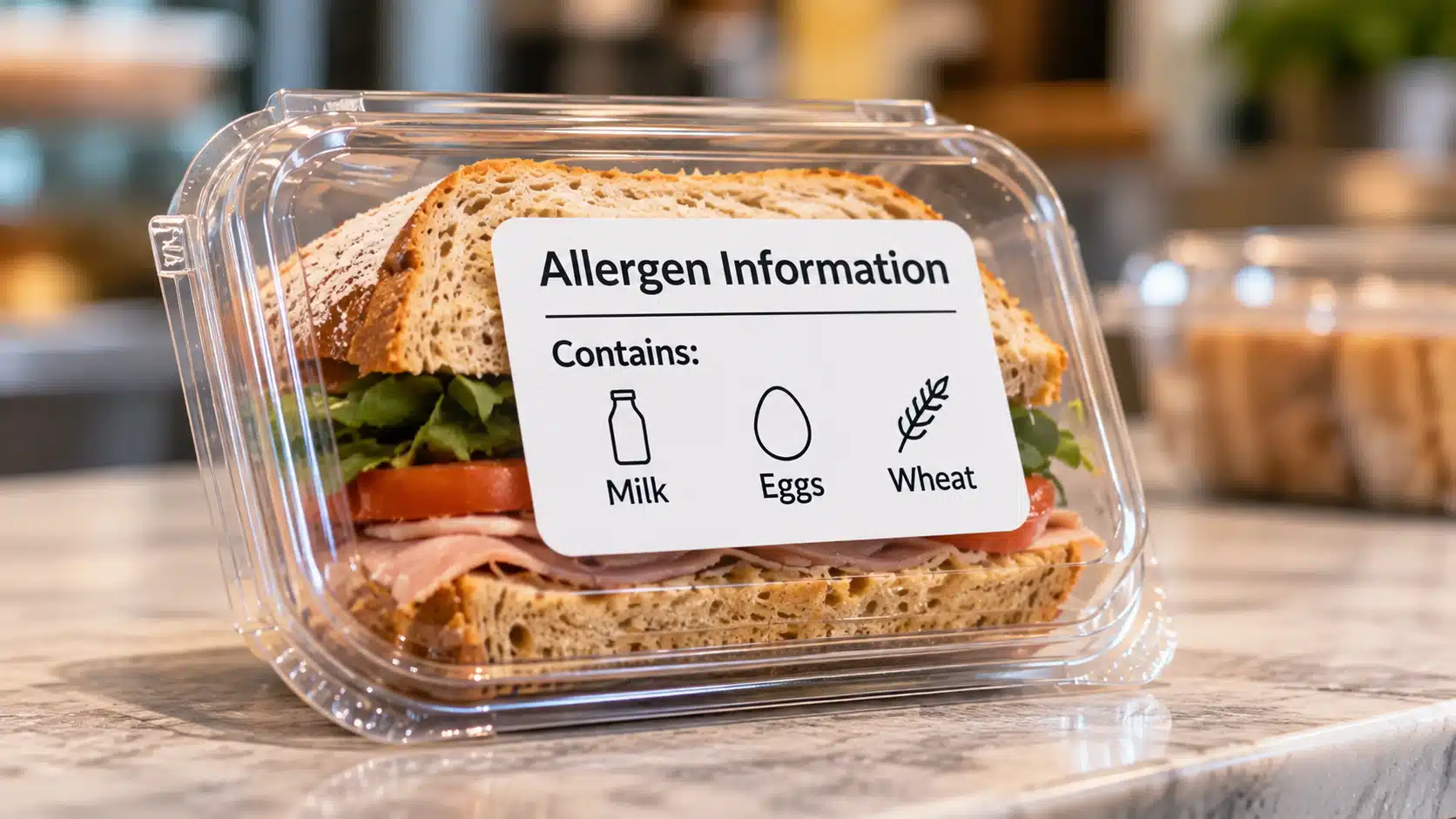
New York has rolled out two new allergen obligations for food businesses in the span of about eighteen months. The first, effective in May 2025, governs notices at restaurants and catering halls. The second, effective November 12, 2026, governs labeling of prepackaged food. They are distinct requirements, and many operators will now have to satisfy both. This article explains each law and what compliance takes.
The new labeling law (effective November 12, 2026)
New York’s newest requirement comes from legislation enacted in 2025 that added two parallel provisions: Public Health Law § 1357 and Agriculture & Markets Law § 199-g, each titled “Allergen labeling for prepackaged foods.” (N.Y. Agric. & Mkts. Law § 199-g (McKinney); N.Y. Pub. Health Law § 1357 (McKinney)) Both took effect on November 12, 2026. (N.Y. Agric. & Mkts. Law § 199-g (McKinney); N.Y. Pub. Health Law § 1357 (McKinney))
Who it covers. The law reaches “food establishments.” Under the Public Health Law, that means any place food is prepared and intended for off-premises consumption, including delis, bakeries, sandwich shops, ice cream parlors, cafeterias, and food trucks operating in the state. (N.Y. Pub. Health Law § 1357 (McKinney)) The Agriculture & Markets Law version is phrased more broadly — any place where food is prepared and intended for consumption, including retail food stores. (N.Y. Agric. & Mkts. Law § 199-g (McKinney)) Together they capture a wide range of businesses that package food for sale on their own premises.
What it covers. The obligation applies to “prepackaged food,” defined as food prepared, prepacked, and sold to customers on the same premises. It does not reach food that is unpackaged or that is packaged only after a customer places an order. (N.Y. Pub. Health Law § 1357 (McKinney)) For that prepackaged food, the business must disclose any ingredient that is a “major food allergen” — the nine federally recognized allergens: milk, eggs, fish, crustacean shellfish, tree nuts, wheat, peanuts, sesame, and soybeans, plus any ingredient containing protein derived from one of them. (N.Y. Pub. Health Law § 1357 (McKinney)) Two carve-outs apply: highly refined oils derived from those allergens, and ingredients exempted under the federal Food Allergen Labeling and Consumer Protection Act of 2004, are not treated as major food allergens. (N.Y. Agric. & Mkts. Law § 199-g (McKinney); N.Y. Pub. Health Law § 1357 (McKinney))
How to comply. The rule is straightforward: label every prepackaged item with a written notification — either printed on the package or on a label attached to it — identifying any major-food-allergen ingredient the product contains. The label does not need to flag ingredients that are not major allergens. (N.Y. Agric. & Mkts. Law § 199-g (McKinney); N.Y. Pub. Health Law § 1357 (McKinney)) In practice, a business should review each prepared-and-packaged product against the nine-allergen list and make sure its packaging or an affixed label states which of those allergens, if any, are present. The requirement applies as of the November 12, 2026 effective date; the statutes do not build in a grace period.
Penalties. The new sections do not contain their own penalty clause. Enforcement runs through the existing mechanisms of Public Health Law Article 13 (for § 1357) and the Agriculture and Markets Law (for § 199-g). No dedicated fine amount or implementing regulation tied specifically to these labeling sections has surfaced, so businesses should confirm their penalty exposure against those general enforcement provisions and watch for guidance from the Department of Health or the Department of Agriculture and Markets.
For those who come under the Department of Agriculture and Marts, such as food stores, grocery stores and processing facilities, the default civil penalty is $600 for the first violation and subsequent repeat violations rise up to $1,200 for each violation. For those policed by the state or local health departments, the penalty should not exceed $2,000 for each violation.
However, it is important to remember that each package which does not have the proper sticker can result in a separate violation and penalty. Moreover, the New York State Liquor Authority has been known to issue separate fines when a licensee has been found to violate health and safety laws.
The earlier notice law (effective May 2025)
The labeling law builds on a separate requirement already in force. Public Health Law § 1356, effective May 21, 2025, applies to “food service establishments” — restaurants and catering halls where food is prepared and served on or off site. (N.Y. Pub. Health Law § 1356 (McKinney))
How to comply. A covered establishment must do two things. First, post a Department of Health notice on food-allergy and intolerance procedures in a conspicuous location accessible to all employees involved in preparing or serving food, in the languages those employees speak to the extent the Department makes the notice available. (N.Y. Pub. Health Law § 1356 (McKinney)) Second, include on every menu — including online ordering menus — either the statement “If you have a food allergy or intolerance, please notify us.” or allergen information for each item, along with any non-English translation the Department provides. Online menus must also either let customers flag an allergy or display per-item allergen information. (N.Y. Pub. Health Law § 1356 (McKinney))
Penalties. A violation of § 1356 carries a civil penalty of up to $125 for each violation. (N.Y. Pub. Health Law § 1356 (McKinney))
Putting it together
The two laws target different points in the customer’s experience. The 2025 notice law is about communication at the point of ordering — a menu prompt and a staff-facing notice at restaurants and catering halls. The 2026 labeling law is about what appears on the package of food a business prepares, packages, and sells on-site. A business that both serves food to order and sells prepackaged items — a deli or a café with a grab-and-go case, for example — may fall under both regimes and should treat them as separate compliance checklists.
A practical compliance path:
- Inventory your products and formats. Separate made-to-order and served items (potential § 1356 territory) from items you prepare, package, and sell on-premises (§ 1357 / § 199-g territory).
- For prepackaged items, confirm each package or attached label identifies any of the nine major allergens present, accounting for the refined-oil and FALCPA exemptions.
- For menus and ordering, if you are a restaurant or catering hall, add the required allergy notice (or per-item allergen information) to every menu, including online, and post the Department of Health staff notice in the kitchen/service area in the applicable languages.
- Monitor for guidance, since implementing regulations for the new labeling sections had not been issued as of this writing.
Keven Danow is an attorney representing members of all three tiers of the Beverage Alcohol Industry and member of The Danow Group, 605 Third Avenue, New York, NY 10158. (212 3703744). Website: thedanowgroup.com; email:kd@thedanowgroup.com
This article is not intended to give specific legal advice. Before taking any action, the reader should consult with an attorney familiar with the relevant facts and circumstances.
Latest News
Stay informed on the critical current issues impacting the beverage alcohol industry

New York City Now Requires Restaurants to Link to Health Grades on Their Online Ordering Sites
What’s new. The New York City Department of Health and Mental Hygiene (DOHMH) is advising restaurants of a new requirement affecting any business that lets customers order food online for same-day pickup or delivery. If customers can place a same-day order through a website or app you operate, that ordering page must now include a […]

New Advisory re Charitable Donation References on Brand Labels 2026-x
The following is a summary of the advisory the SLA adopted in September of 2026. 1. Charitable Donation References on Brand Labels (2026 Advisory) Please bear in mind that while it is not in the Advisory, under New York Law Businesses engaged in cause advertising are classified as commercial co-venturers and are subject to mandatory […]
New Employee Records Law
The Personnel Records Law taking effect November 8, 2026 is a New York State law. It was enacted as L.2026, c. 293, and adds a new Section 210-b to the New York Labor Law N.Y. Lab. Law § 210-b (McKinney). Governor Kathy Hochul signed the bill (S3460) on September 9, 2026, and it takes effect […]